★★★★
RON'S NIGHT OUT
Jenna Covarrubias
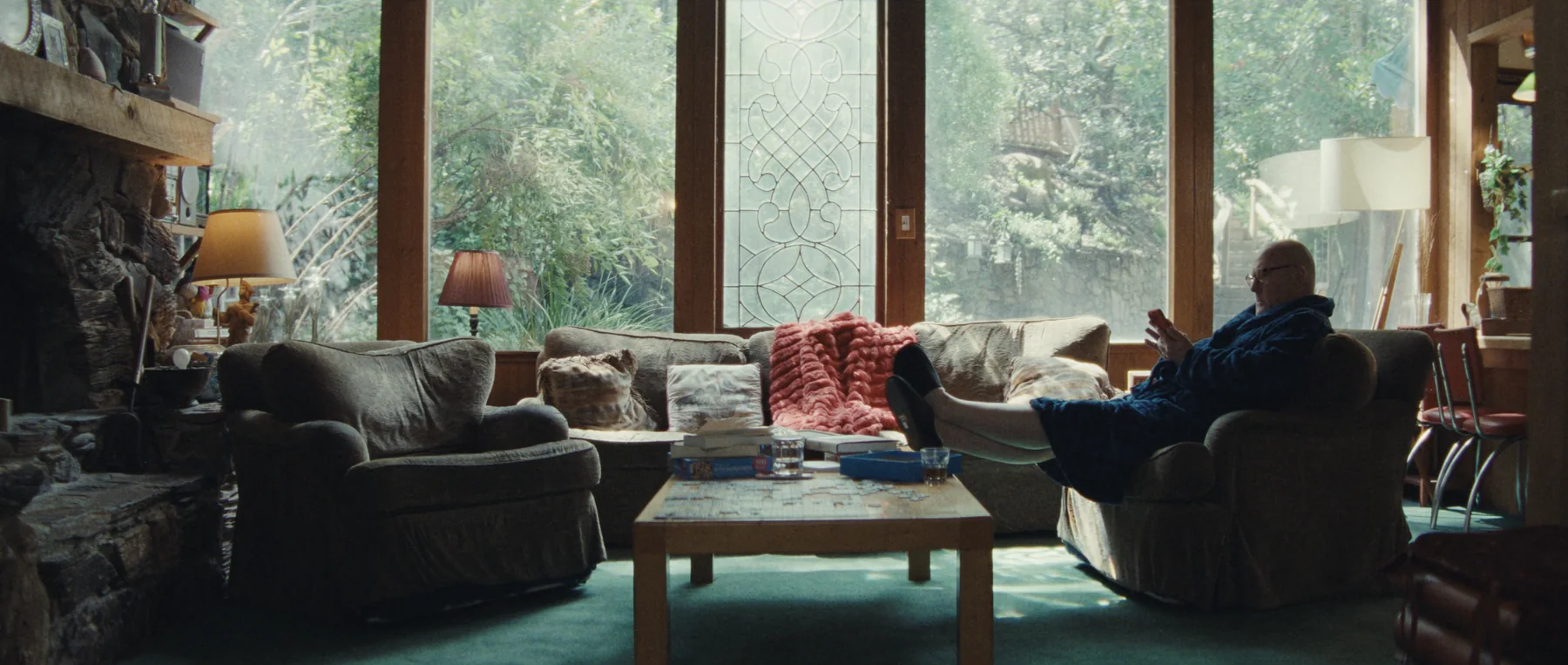
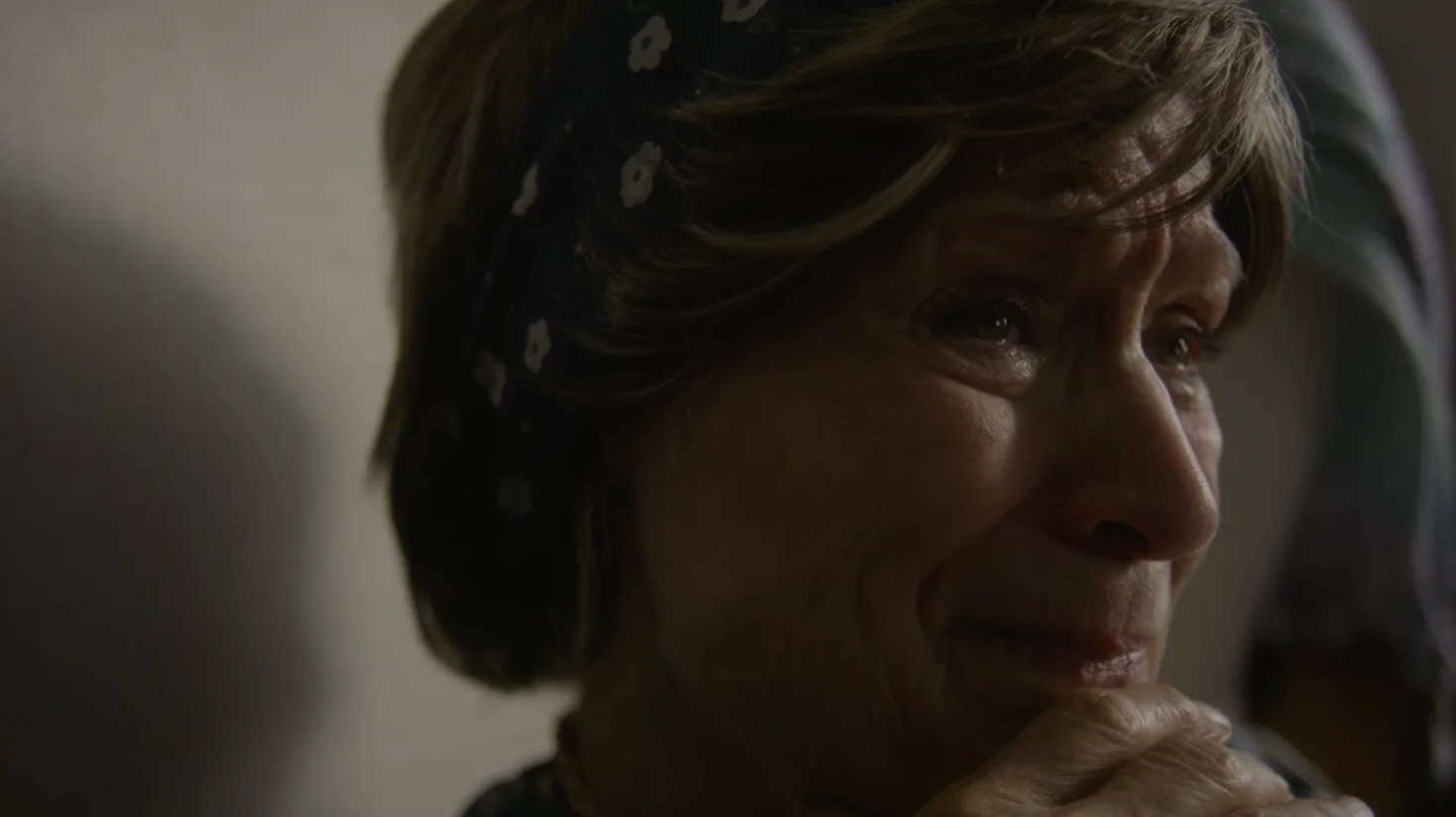
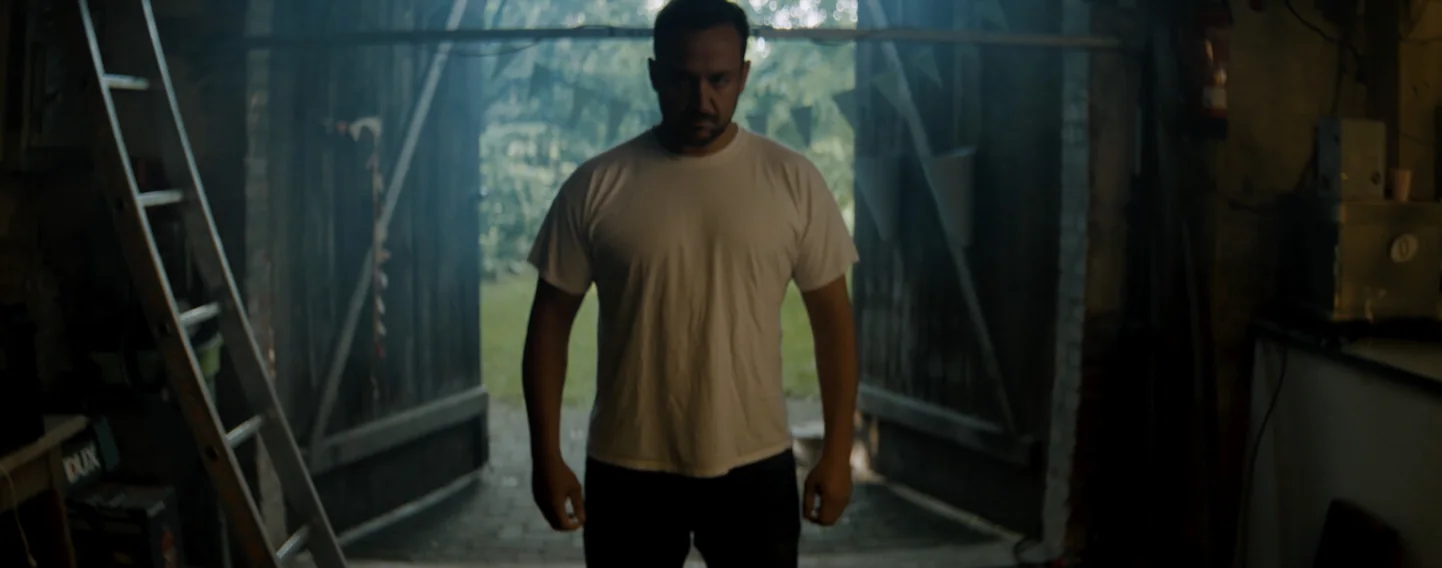
Off the coral reefs of the Indo-Pacific, the clownfish makes its home inside the sea anemone, nestling among tentacles that would paralyse any other fish, protected by nothing more than a thin coat of mucus and an unwavering faith that the thing embracing it will not sting. Jenna Covarrubias hands us this image by way of a glorious slip of the tongue, when Ron, the lonely fifty-something at the heart of Ron's Night Out, asks his date whether she had suspected him of being a "clownfish". He means catfish, naturally; she tells him she likes his version better, and by the end of these thirteen breathless minutes, so do we. Covarrubias, who writes as well as directs, opens on a self-help voice assuring its listener that admitting you are tired does not make you any less of a man, then pulls up a chair for us at a diner table where Ron (Timothy Durkin) is joined by a woman who arrives late, apologetic and sparkling, blaming the traffic and an accident on the way in: "Everyone's okay, luckily." Let me say it plainly and at the outset: the cinematography is impeccable, every frame composed with a poise that lets the comedy breathe whilst dread pools quietly in the corners; the direction is assured to the point of cheek, never once tipping its hand; and the performances are pitched with a precision that most features would envy. Durkin gives us a man in perpetual apology, a middle-school vice principal who retracts his own jokes the instant he makes them ("No, I'm kidding"), and whose gratitude for being dragged out of the house is so naked it almost hurts to watch. Opposite him, his date is played with a quicksilver warmth so generous that it becomes, in hindsight, a question in itself. It is the most tender lonely-hearts duet I have seen since Marty (1955, Delbert Mann), right up until the film decides, with a devilish grin, that it would rather be something else entirely.
Beneath its sitcom-bright surface, Ron's Night Out is a quietly devastating study of what we might call the masculine crisis of disclosure, and it could hardly be more of its moment. In 2023 the US Surgeon General declared loneliness an epidemic, and the film's opening sermon (honesty is where real strength lives; growth rarely feels heroic) belongs to the booming therapeutic marketplace that Eva Illouz has diagnosed as emotional capitalism, in which intimacy is coached, packaged and sold back to the very men it has starved, the same transactional romance that Materialists (2025, Celine Song) dissects with actuarial precision. Covarrubias then proceeds, with exquisite irony, to stage a date in which nobody is being entirely honest, and the film's true leitmotif surfaces as a single, overworked word: okay. "You're okay. You're okay. I'm fine." "Everyone's okay, luckily." "That's okay." "Are you sure everything's okay?" Repeated like a rosary, it becomes what Roman Jakobson would call a phatic utterance and what Erving Goffman would recognise as front-stage impression management, a lacquer of reassurance laid over a back stage the film keeps tantalisingly locked. Ron's grief, meanwhile, belongs to the category the psychologist Pauline Boss termed ambiguous loss: a mourning without a corpse. When his date offers condolences for his late wife, the correction is a masterclass in comic deflation (she is very much alive, having left him for her karate instructor), yet the gag lands precisely because it exposes the Freudian chasm between mourning, which completes its work, and melancholia, which cannot, since the lost object is still out there, presumably perfecting her roundhouse kick. Add the film's Lacanian undertow, its sly intuition that there is no such thing as a sexual relationship, only the fantasies two strangers project at one another across a plate of pancakes, and you have a short that interrogates masculinity, desire and the dramaturgy of the first date with a rigour that never once forgets to be funny.
Stylistically, Covarrubias works in the grand tradition of the diner as pressure cooker, that most American of confessionals, where Pumpkin and Honey Bunny plot their stick-up over coffee in Pulp Fiction (1994, Quentin Tarantino) and where the women of Death Proof (2007, Quentin Tarantino) trade stories, blissfully unaware of the stuntman and his car. Her register, though, sits closer to the deadpan of Fargo (1996, Joel Coen), all good manners and lethal undercurrent, and to Something Wild (1986, Jonathan Demme), in which a buttoned-up man is swept out of a diner by a woman who, like Ron's date, simply felt like being spontaneous. The genre she most gleefully raids is the predatory-date thriller, and here she performs a genuinely canny act of inversion. Where Fresh (2022, Mimi Cave) and Drop (2025, Christopher Landon) seat a woman across the table from danger, Ron's Night Out swims in the same waters as Audition (1999, Takashi Miike), with its lonely widower auditioning a future wife, Under the Skin (2013, Jonathan Glazer), with its unhurried pick-ups of solitary men, and, more recently, Strange Darling (2023, JT Mollner) and Companion (2025, Drew Hancock), both of which take wicked delight in reshuffling who exactly is prey. Carol J. Clover's theory of cross-gender identification, in which horror asks us to ride along with its most vulnerable body, is here applied, deliciously, to a man in his fifties, whilst Barbara Creed's monstrous-feminine hovers somewhere just beyond the edge of the frame. And in Ron himself there is something of Tim Robinson's agonisingly needy everyman in Friendship (2024, Andrew DeYoung) and Nicolas Cage's bewildered nobody in Dream Scenario (2023, Kristoffer Borgli), men whose desperation to be liked is both their charm and their undoing. That Covarrubias can hold all of these echoes inside thirteen minutes without the film ever feeling derivative is testament to a director in full command of her instruments.
What I found most interesting, and most delightful, is how Covarrubias's script turns small talk into a minefield of dramatic irony. Consider the toast: before the glasses of house red meet, Ron's date warns him that failing to make eye contact means seven years of bad sex, to which he replies that he would be lucky to get one year of any sex at this point. It is a gorgeous little joke and also an apotropaic rite in miniature, a superstition performed to ward off misfortune in a film about misfortune that declines to be warded off. Or the eggs: Ron defends pairing his cowboy scramble with red wine on the grounds that the tannins will bring out "the henness of the eggs", a coinage so magnificently absurd that his date promptly anoints him a sommelier. Then come the photographs of his children, "a man and a woman at this point", who will nonetheless always be his babies, a beat of such unguarded paternal pride that it caught in my throat, and in which even a question about where they live passes for perfectly innocent small talk. Doesn't it? And then the hairline crack, the most innocuous exchange in the film and, I suspect, the most important: an invitation to go "back to yours", an offer to call an Uber, a gentle query ("But didn't you drive?") and a reply ("Oh, yes. Right.") whose chill arrives on a slight delay, like the finish on a glass of house red. The clownfish slip, too, rewards the psychoanalytic eye. It is a textbook parapraxis, the moment Freud tells us the unconscious smuggles out a truth the speaker never meant to tell, for what is Ron, after all, but a gentle creature who has learned to live, unharmed for now, among the stinging tentacles of the world?
If Ron's Night Out has a moral, it is a deliciously double-edged one: the self-help voice that opens the film is quite right that honesty is where real strength lives, and the film is equally right to suspect that the modern dating market, with its catfish and its clownfish, is the last place anyone goes looking for it. I shan't spoil where this particular ride terminates; Covarrubias has earned her surprise, and you should meet it as Ron does, with a glass of house red in hand and your guard regrettably down. I will say, however, that the film's affective power lies in its refusal to let laughter and dread cancel each other out. We laugh at Ron, then with him, then for him, and that final movement, from mockery to tenderness to fear on his behalf, is the transcendental trick of the whole enterprise: it makes us love a man whom cinema would ordinarily leave sitting alone at the counter. Jacques Derrida opened "The Law of Genre" with the deadpan decree that genres are not to be mixed, then spent the rest of the essay proving the law impossible to obey; Covarrubias, it seems, skipped straight to the conclusion. Which brings me to a personal note, Jenna. You have spoken of feeling expected, as a Latina filmmaker, to tell certain kinds of stories, and of a body of work that, like its maker, refuses to fit neatly into a single genre. Please never apologise for that refusal, because on the evidence of this film it is not a liability but your signature. You belong to a proud lineage that runs from Ida Lupino, whose The Hitch-Hiker (1953, Ida Lupino) turned a car journey into a nightmare long before Hollywood believed a woman belonged at the wheel, to Issa López, whose Tigers Are Not Afraid (2017, Issa López) proved that genre and grief can share a single frame. Keep mixing, keep subverting, keep making films that refuse to sit still in their seats. You hoped we would enjoy the ride, pun intended. I did, enormously, and I cannot wait to see where you drive us next.
Read Full Review